

Mindfulness & Well Being in Nature
Spending time in nature is a powerful support for your well-being, bringing increased joy, mental clarity, sense of meaning in life, and creativity, as well as decreasing stress, anxiety, and depression.
As you walk along the trail, the guided practices will help you deepen your experience and reap the mental health benefits of engaging in nature and outdoor spaces.
Put Away Your Phone
It's time to take a green micro-break.
In our fast-paced world, it is easy to get stuck in cycles of stress. And all too often, smartphones and social media allow us to carry the demands and anxieties of daily life into every moment.
Green micro-breaks are short (often 1-10 minute) nature experiences that allow for a quick mental reset. By taking time away from screens, work demands, and other encroachments, and placing our attention on the vibrant life around us, we can weave beauty and nature connection into the flow of our day.
From a simple view out the window of the open sky to your walk along this campus trail, green micro-breaks are a free and accessible support for your well-being.
Listen to the audio clip and follow along with the narrator.
MENTAL HEALTH BENEFITS: Improved sense of well-being, increase in sustained attention and focus, decreased anxiety, improved sleep quality (San Jose Mental Health)
Listen (00:59)
Transcript
Welcome to the Copeland Creek Trail!
As you walk along the path, we invite you to give yourself a break from the demands and pressures of daily life.
You can begin by feeling the contact of your feet with the ground, and picturing the stresses and concerns of daily life flowing out through your feet to be composted in the ground. You can re-gather them later if you wish: you’ll find that the break makes you better able to deal with them.
Once you’ve finished listening to this audio, put your phone away for a while, so you can walk free of interruptions. Let yourself feel lighter. Notice the trees and plants along the trail, listen to the birds and feel the air. Follow your curiosity, see what catches your eye. And remember that these “green breaks” are here for you, whenever you need them.
Three-Minute Nature Observation
These days, we all seem to face endless demands on our attention, with busy schedules of work and study, and too little downtime. It isn't surprising that people are feeling increasingly scattered, depleted, and fatigued. We can think of our ability to focus as being like tea in a teacup: we only have a certain amount of it, and when it runs out, our teacup needs to refilled. How can we "refill the teacup" and replenish our mental energy? Luckily, one of the best cures for mental fatigue is abundant in nature. A growing body of evidence based on "Attention Restoration Theory" has demonstrated that time spent in nature is one of the most effective ways to refresh our minds and re-establish clarity and focus. From early research showing that a 20-minute walk in the woods helped children with ADHD focus (to an extent comparable with taking their medication) to numerous studies on college students and other adults (with or without ADHD), we know that even a short time in nature can work wonders on the mind. In a classic study, students at the University of Michigan recovered more fully from a mentally draining task after a 50-minute walk in a green park than after a walk in an urban area. A recent article reviewing multiple research studies found "green breaks" as short as 10 minutes to be restorative of memory and attention.
So next time you notice that you've read the same page twice and still don't know what it says, put your book or laptop down and go outside. If you have time, come back here to walk along the Copeland Creek trail. Or if you're crunched for time, just step outside, look at the sky, and feel the breeze on your face. Connect with nature to refill your teacup - your brain will thank you.
Want to learn more? An excellent review can be found here.
MENTAL HEALTH BENEFIT: increase in focus & mental clarity
ACTIVITY: Notice a Plant
You can engage your clarity and focus by bringing your full attention to a nearby plant. Choose a plant that interests you in some way, one that inspires your curiosity.
NOTE: We have three plants that would be best not to touch: poison oak, poison hemlock, and stinging nettles. The links and below photos will help you identify them.
Move closer to your plant, and carefully observe a leaf. Notice the color, the texture, and the patterns of the leaf. Take in as many details as you can, perceiving features that would typically escape you.
Then expand out to explore the form of the plant as a whole. How do the leaves attach to the stem? What can you see, with sustained, inquisitive attention, that is novel or surprising?
If it is safe to do so, engage other senses: what does the plant feel like? Is there a scent?
If you would like, you can use your phone magnifying glass to explore the invisible details of the plant.
Finally, if you have paper and a pen or pencil, spend some time drawing your plant: you’ll be amazed at the additional detail that you notice through drawing.
Avoid These Plants
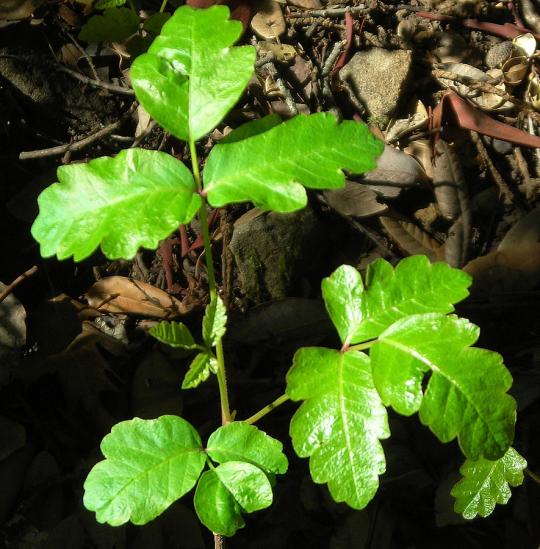
| Poison Oak |
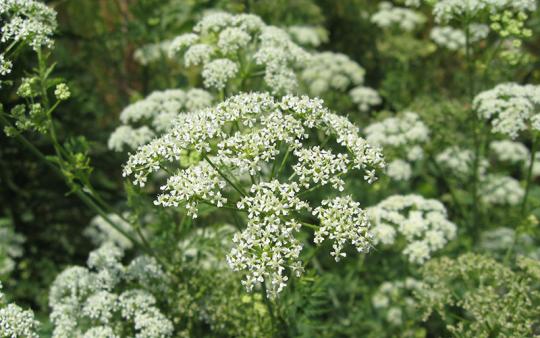
| Poison Hemlock (Photo by: MN Dept. of Natural Resources) |
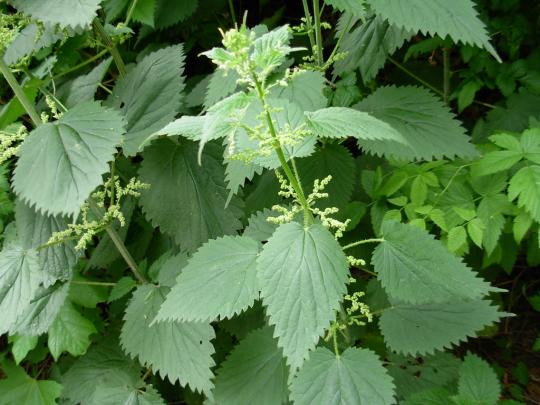
| Stinging Nettle (photo by BrewBooks) |
Centering & Grounding
Anxiety and stress can sometimes become a regular feature in our day-to-day lives. Taking a moment to get into nature can help you focus on the present, slow your breathing, and give your body and mind a break.
This activity helps you remember to be present and engaged with the environment around you — which can decrease stress and anxiety and improve your physical and mental well being.
Listen to the audio clip and follow along with the narrator — SSU CAPS representative, Claire Terzich.
MENTAL HEALTH BENEFITS: stress relief, focus, calm, reduced anxiety, nervous system regulation
Listen (00:59)
Transcript
Begin by bringing your attention to your environment. Find a tree you want to align yourself with and turn your body towards it.
You may close your eyes, if comfortable, or maintain a soft gaze, not focusing on anything too intensely.
Take a deep breath Breathe in for the count of four... 1 — 2 — 3 — 4... Out for 4... 1 — 2 — 3 — 4
Now let's take another one, but as you breathe imagine that the oxygen being produced by the tree is flowing through your body, enlivening you. That you are one with the trees, the grass, the air, the soil that feeds our earth.
Breathe in for four... 1 — 2 — 3 — 4... Out for 4... 1 — 2 — 3 — 4
You may notice various sounds coming from different areas. Acknowledge them, accept them, and focus on the sensation of feeling.
You may notice your feet on the ground now, think of that tree you aligned yourself with and imagine its roots that go deep into our earth. We are a part of nature. Alive and growing, just like the trees. Imagine you have roots on the bottoms of your feet that stretch deep and connect you to the earth. You are a tree, still … but even if you are still, you are alive.
There may be anxieties in your life, things that make you feel like you don’t have control or fill you with worry or uncertainty for the future. Today, in this moment we acknowledge those feelings. We accept them, but we understand that you are alive and worthy and that taking a moment to pause and reflect is okay and necessary to truly be alive.
To be alive is to sometimes be still. Like a tree, letting the breeze move you, or letting yourself feel air flow around you.
Take another deep breath Letting the oxygen enliven you. Breathe in for four... 1 — 2 — 3 — 4... Out for 4... 1 — 2 — 3 — 4
When you are ready, slowly open your eyes and look at that tree again. You are different from this tree, but you are both alive and are nature together.
Now allow your head and neck to gently rotate, if you are able, to feel the space around you.
As you go along the rest of your day, take with you the power of stillness as a gentle reminder that you are alive and worthy to take that pause.
Forest Therapy — Nature as Medicine
Engaging with the natural world around us can help heal us internally.
The Japanese call the practice of immersing in nature "shinrin-yoku," or forest bathing and involves engaging all of your senses in a relaxed and calming way.
In this recording, you will be guided to pay close attention to the sensory details around you to develop a feeling of presence in and connection to nature.
Forest immersion experiences like this have been studied to decrease levels of stress and anxiety, as well as increase mood, feelings of connectedness and well-being, and even help boost the immune system.
MENTAL HEALTH BENEFITS: stress relief, calm, reduced anxiety, improved mood, improved attention, increased feelings of connectedness, immune system boost
Listen (00:59)
Transcript
Welcome to the Copeland Creek corridor. I am going to lead you through a short invitation to become more aware of your body immersed in and connected to the natural world around you. This is inspired by the practice of forest therapy, otherwise known as forest bathing. Forest bathing is a direct translation from the Japanese, Shirin Yoku. Bathing here means immersion in Nature. Studies show many health benefits from regularly immersing ourselves in the natural world, especially when we slow down and pay attention to the spaces around us.
In this exercise, we are going to pay attention to our senses, one by one. I invite you to begin by finding a place that feels safe and comfortable to you. Gently look around and notice things from the natural world that surround you, look side to side, up and down, near and far.
Now, pay attention to your body’s point of contact with the ground - perhaps rock back-and-forth on your feet. As you bring awareness to your body, does it want to move or shift positions? Feel free to move as needed.
Bring your attention now to your skin - notice where your clothing touches your skin. Also notice the air around you and how that feels on your skin - your hands and arms, or your face. Can you feel the wind blowing over your skin? Perhaps hold your hands out and splay your fingers. If you feel comfortable, pick up something natural from the ground, or, feel the fabric of your clothing on your own skin. Consider what it feels like to be touching something - the temperature, the shape, the texture.
Now bring attention to your breath, there’s no need to change your breath, but rather pay attention to the air as it passes in and out of your lungs. Consider where the air is coming from. Can you detect any smells as you breathe in? Do they change if you move your head from side to side, or up and down?
Now let’s bring attention to the sounds around you. There may be many sounds around you - some louder, some softer, some near and far, human and non-human sounds. Spend several seconds paying attention to all of the sounds that you hear. Consider, is there a rhythm to any of the sounds?
We will now bring our attention back to our eyes, please refocus your gaze. Look all around and notice a being from nature that your eyes are drawn to. Perhaps it is a plant, a tree, or a rock. Perhaps it is something else. Consider what you are looking at - tune into the connection of your body to the natural world, here and now, on this Earth.
Gratitude
Cultivating gratitude toward nature is a powerful way to increase happiness and well-being.
Gratitude is “a felt sense of wonder, thankfulness, and appreciation for life.” It's an affirmation of the blessings in our lives, and in the world. It involves an attitude of humility, and acknowledges our interconnectedness, recognizing that other people, nature, and perhaps a higher power, are sources of sustenance and joy in our lives.
It’s human nature to focus more on the negative than the positive. Gratitude helps us to counteract this “negativity bias” by consciously acknowledging the good. Nature is an abundant source of gifts, from the specific (the fresh aroma of a forest) to the global (providing the conditions that make our lives possible). But it is all too easy to take these things for granted. When we cultivate gratitude for nature we foreground these often-overlooked gifts.
The experience of gratitude brings many benefits, including:
- Physical well-being (immune strength, better sleep, lower blood pressure, better self-care such as exercise)
- Psychological well-being (joy and pleasure, general positive emotion)
- Social well-being (generosity and compassion, ability to forgive, feeling connected to others and the world)
Whether we focus on the inspiration that we feel in the presence of natural beauty, the soothing quality of a walk along the creek, or the food, water, and air that make our lives possible, spending time in nature is a delightful path to gratitude and an effective way to support our well-being.
Listen to the audio clip and follow along with the narrator.
MENTAL HEALTH BENEFITS: improved mood, decreased stress & anxiety, deeper interconnectedness
Listen (00:59)
Transcript
Take a few moments to get comfortable, feeling your connection with the ground through your feet, taking some deep breaths into your heart, feeling the air as it enters your body and leaves your body… Allow yourself to transition from your everyday state of mind into something quieter, more open and connected.
We’re going to focus on sending gratitude to nature. Take a moment to reflect on the gifts that nature, and all the beings that live there, bring to you. All that they give of themselves that enriches your life, whether it’s the food that grows from the earth, the air that you breathe that is created by the trees, the beauty of the flowers or the inspiration of the birds, whatever it might be. Allow yourself to savor the gifts that they bring to you. You may find that gratitude wells up naturally in response.
When it does, silently send out a deep, heartfelt “thank you.” Thank you” to the trees and plants around you. To the sky, to the birds, to any animal or insect who may cross your path, “thank you.” To nature as a whole, “thank you.” And as you send out gratitude, let yourself sink even more deeply into an awareness of all that these beings offer you.
I invite you after the instructions end to take as much time as you wish to continue the practice, noticing all the gifts that are constantly streaming from the world to you, savoring them, and from the depths of your heart sending your gratitude back out.
Letting Go of the Busy Mind
The act of looking around -- and seeing, smelling, and hearing what's around you can help you let go of the heaviness of life -- whether it's assignments, tests, work, personal challenges, or even eco-anxiety or concerns about the future.
This exercise will help you find balance as you engage with the air, water, and land around you.
Listen to the audio clip and follow along with the narrator — SSU CAPS representative, Valeria Lorenzana.
MENTAL HEALTH BENEFITS: Calm, awareness, improved breath control, appreciation
Listen (00:59)
Transcript
Sometimes it’s hard to explain why we come to places like this. Maybe it’s to clear our heads… or maybe it’s just to be somewhere quieter for a little while.
Life can start to feel heavy sometimes. Sometimes it’s just there in the background. At times it’s just exhaustion... or feeling disconnected… or like your mind has been carrying too much for too long. And when that happens, even small things can begin to feel distant. But being out here can help bring some of those things back into focus.
As you walk, take a moment to notice what’s around you. The sound of leaves moving in the wind… the light coming through the trees… the feeling of the ground beneath your feet. Maybe there’s a breeze… or the sound of water nearby… or a part of the trail that catches your attention for no particular reason.
Try noticing five things around you right now — One sound. One color. One movement. One texture. One smell. There’s no right way to do this. Just notice what’s here.
Now take a slow breath in… and let it out. Again… in… and out.
See if anything feels even slightly softer than when you started. Maybe your shoulders relaxed a little. Maybe your breathing slowed down. Maybe nothing changed much at all. That’s okay too. Sometimes the smallest shifts matter the most. Sometimes it’s just a small moment where things feel a little less far away.
As you continue walking, think of two small things you appreciate right now. Maybe one thing from nature — the shade from the trees, the fresh air, the sound of the creek. And maybe one thing from your own life — Something simple. A person. A memory. A warm drink this morning.
The fact that you made time to be here at all. Small things still count. For me, walks like this are a reminder that I don’t always need to solve everything at once. Sometimes it’s enough to just keep moving forward quietly… one step at a time. This trail doesn’t rush you. It just continues. And maybe you can let yourself do the same.
Before you leave, take one last look around. Notice something you didn’t see when you first arrived. Maybe that’s part of this too — remembering that even when life feels heavy, there are still things waiting to be noticed. And maybe, for now, that’s enough.
Creativity
Time spent in nature nourishes our creativity: the ability to bring something new into existence, including new thoughts and perspectives. Visual artists, musicians, writers and scientists such as Georgia O’Keefe, Black Pumas, Virginia Woolf, and Albert Einstein have found inspiration in and through nature. But nature’s ability to expand our minds in new directions isn’t limited to creative luminaries: it is available to all of us. From studies of students on a four-day backpacking trip to people looking at photos of nature in a lab, there has been a consistent connection between nature and creative problem-solving.
How does this relate to mental health? We can all benefit from a nimble mind that can bring flexibility and insight to life’s challenges. In addition, the connection between nature and creativity has been linked to mind wandering. If you’re like most people, your mind likes to wander. As soon as we don’t have a specific task to focus on, our minds are off and running, mulling over various issues, daydreaming, and planning. Depending on the particular ways that the mind wanders, this can be beneficial or damaging to our well-being. Our wandering minds often gravitate toward ruminating over negative events, which can lead to anxiety and depression. But there’s a more nourishing aspect of mind wandering, a kind of relaxing creative floatiness that is engaged more easily when in nature. In fact, when people walk in nature, they obsess over negative thoughts much less than when they walk in the city. In other words, nature supports the positive aspects of mind wandering and minimizes the negative. If you're prone to overthinking, nature is good medicine.
Listen to the audio clip and follow along with the narrator.
MENTAL HEALTH BENEFITS: improved attention, inspiration, creative problem solving
ACTIVITY: Creativity in Practice
Walk across the Copeland Creek Trail to the edge of the field. If you would like, you can sit on one of the benches, or go into the circle of redwood trees. As you spend time in this place, supported by the trees, the open sky, the broad expanse of the green field, and the nearby lake with its abundant life, take this opportunity to put nature’s creativity to work in your life.
- Bring to mind a question that has relevance and meaning for you, preferably one that would benefit from a new, creative perspective.
- Once you have your question, send it into nature. You can imagine that you are releasing your question into the vastness of the sky, burying it in the ground, or placing it in a stone or a plant.
- Alternately, in place of your usual internal monologue about your question, you can have an inner “conversation” with a tree, a bird, the wind… any natural being or feature that calls to your attention. What does nature have to say to you?
- Either way, hold your question with lightness. No need for overthinking, or forcing an answer. Think of this as an incubation process: you are planting a seed. A new perspective may sprout immediately, or later when you least expect it, in a quiet moment or even in a dream.
Just Like Me
It is widely known that social connectedness is one of the most important contributors to mental health. We humans are social beings, and we need relationships with others in order to thrive. (This doesn’t mean that we all need to become extraverts: there are many ways for introverts to connect meaningfully). Interestingly, spending time in nature helps us to connect well with other people. Numerous research studies have found that nature makes us more prosocial. Time in nature helps us to be more aware of the perspectives and needs of others, and to feel more of a sense of solidarity and community. And people act on these feelings, becoming more helpful and generous. Nature’s power to bring us together is particularly notable in urban settings: for example, a series of studies of public housing in Chicago found that residents who lived near trees had stronger sense of community cohesiveness, felt safer, and had better ties to their neighbors than people living in treeless areas.
Interestingly, time in nature can also directly meet people’s social needs: those who have relatively few connections with other people are less vulnerable to depression if they have access to nature near their home or neighborhood. And if we choose, we can consciously deepen our social connections to the myriad beings we encounter in nature. Throughout time and across cultures, people have found many ways to engage thoughtfully and respectfully with the diverse forms of life around them. Listen to the attached audio recording for instructions.
Listen to the audio clip and follow along with the narrator.
MENTAL HEALTH BENEFITS: Social connectedness, love, and compassion
Listen (00:59)
Transcript
In this practice, you’re going to work with extending a feeling of connection to the animals around you. To begin, walk across the Creek Trail toward the oak tree that overhangs the pond, and find a comfortable place where you can feel supported for the next few minutes, either standing or perhaps sitting on the ground with your back against a tree for support. Pause the recording as you find your spot.
Now that you’re settled in, take a couple of nice, deep breaths into the heart. Let your awareness start to settle, so that you're less distracted by thoughts and self-talk. And as your mind starts to quiet down, become more aware of what's happening around you. Many animals tend to congregate here: geese, ducks, and a variety of other birds, squirrels… perhaps you can spot a turtle in the water.
As you're bringing your awareness more fully to this place and the animals that live here, I invite you to focus on one in particular. This can be a mammal, bird, or insect: any of these are good starting points. Choose one who is currently here with you. And as you do so, bring to mind that despite whatever differences there are between you and this other being, there are also some basic commonalities, such as that just like you, this being wishes to thrive, basically wishes to be happy. Of course, happy means something different for a bird or a squirrel or a butterfly. But in whatever inner sense that this being has, they wish to flourish, to be well, to have their needs met. So just taking some time to really bring into the forefront of your awareness, this similarity between you and this other being. Just like you, they want to thrive, they want to be happy. And taking some time to really explore that, to contemplate it.
And that along with that, consider that just like you, this being wishes not to suffer. And again, suffering means something different to a turtle or a goose than to a human, there are different versions of this feeling, within different beings. But we all share the essential sense of avoiding what is harmful and the feelings that go with that. So in that respect, this being, just like yourself, wishes not to suffer.
In fact, this wish to thrive, and this wish not to suffer, unite all beings. By bringing this to the forefront of our awareness, we can start to bridge whatever unconscious sense of separation that we've developed with those around us who aren’t human.
And after this recording is over, I encourage you to continue the practice with a diverse array of different beings. Animals, even plants, whoever happens to be around you in your field of awareness, remind yourself of this shared experience with the phrases, “just like me, they wish to thrive.” “Just like me, they wish not to suffer.” And let it be more than just a repetition of the phrases, but to really lean into that awareness, and feel it as fully as you can.
Breathing with Trees & Plants
This practice will take place in the Native Plant Garden. To go there, walk across the Creek Trail and into the forest. You’ll see a sign that says “Butterfly Garden” – there’s a path just to the right of that sign. The path will take you to a small clearing where you’ll be surrounded by trees. You’ll find a place to stand, to sit on the ground, or on one of the benches. Choose any spot where you are comfortable and near trees. Pause the recording now, and resume it once you have arrived.
Listen to the audio clip and follow along with the narrator.
MENTAL HEALTH BENEFITS: well-being, reduction of depression
Listen (00:59)
Transcript
Now that you’re here among the trees, take some time to get comfortable. This practice focuses on the breath. To begin, let your breath settle into its own natural rhythm. Gently bring more and more of your attention to the breath, feeling the breath as it enters your body, and feeling it as it leaves your body. And with each cycle of breathing, let your awareness be gathered by the breath, bringing your mind home, so to speak, so that any distracting thoughts, or anything that's been on your mind, just gradually drops away. Come into a fuller sense of presence in this moment.
And as you continue to breathe and to bring your awareness very gently to the breath, remember that your breath happens in relationship to the trees and plants around you as well as those that are more distant. The breath of plants gives life to animals, including us, and the breath of animals gives life to plants. So as you're breathing, let part of your awareness stay with the direct, simple awareness of the breath itself, but let another part of your awareness really savor this knowledge that every inbreath is a gift from the trees and plants around you. And every outbreath is a gift to them in return. You and your green friends are breathing together. You are breathing in plant air. And they are breathing in animal air.
Take this general knowledge, and let it come to rest on a particular nearby tree. Knowing that some of your inbreath is coming from this tree, and some of your outbreath is going to the tree. You might say silently, in your mind, “my breath is your breath, your breath is mine.” Just let yourself stay with this awareness. No need to force anything. Just being gently aware that through the simple act of breathing, you're engaged in a give and take with the beings around you. “My breath is your breath. Your breath is mine.”
And as you continue this practice, you have the opportunity to contemplate some questions, and perhaps to gently shed some habits of thinking. Perhaps you've thought of this process of giving and receiving breath in a somewhat mechanical way, simply as an exchange of molecules, devoid of mystery or meaning. See if you can put that aside. When you think of your body, and the bodies of the trees and the bodies of the plants, let yourself feel the inherent mystery and aliveness of these bodies, your own and theirs. Even the air itself. Let yourself open to the living presence of the air. The mystery of the air.
And when you're ready, let go of all of these contemplations and just bring your attention back to the simple direct sensations of the breath, breathing in, and breathing out. And when you're feeling ready, open your eyes if they were closed, and bring this practice to completion.
Well Being in Nature
In many cultures across the world and throughout time, people have experienced themselves as deeply interconnected or intertwined with other people, their communities, and the more-than-human world. This sense of interconnectedness can be a powerful support for well-being. Whether experiencing oneself as part of an inclusive community of people, enjoying a sense of kinship with the surrounding animals and plants, or an awareness of our ongoing physical and emotional exchanges with the world around us, a sense of interconnection supports the ability to navigate life’s changes and unpredictable nature, respond to personal challenges with resilience, and counter the pervasive sense of isolation experienced by so many in modern Western society. Time spent in nature can offset our self-focus in ways that benefit our mental health and broader relationships.
In the words of ecophilospher David Abram, “Our bodies have formed themselves in delicate reciprocity with the manifold textures, sounds, and shapes of an animate earth – our eyes have evolved in subtle interaction with other eyes, as our ears are attuned by their very structure to the howling of wolves and the honking of geese…We are human only in contact, and conviviality, with what is not human.”
We can become more aware of our interconnectedness through simply observing the relational nature of our breath. Listen to the attached audio recording for instructions.
Listen to the audio and follow along with the narrator — SSU CAPS representative, Ava Gorman.
MENTAL HEALTH BENEFIT: interconnectedness with the world
Listen (00:59)
Transcript
Hi… I’m really glad you stopped here. If you’re a student — or someone who’s been feeling overwhelmed — this space is for you.
Life can get really busy. There’s always something to do, something to worry about, something you feel like you should be working on. And sometimes anxiety makes it hard to slow down. Your thoughts keep going… even when you want a break.
That’s why places like this matter. Right now, you’re surrounded by nature — the trees, the air, the sounds around you. Take a moment to really notice it.
Look at the way the light moves through the leaves… Listen for the creek, or the wind…
Now take a slow breath in… and let it out. Again… in… and out.
Nature has a quiet way of helping us reset. It doesn’t take your stress away completely — but it gives your mind and body a chance to rest. Your heart rate can slow down. Your breathing can become deeper. And your thoughts don’t feel quite as loud.
For students especially, this can be really important. You’re often expected to always be “on” — studying, planning, thinking about what’s next. But you’re allowed to pause. You’re allowed to step outside of that for a moment.
Right here, the trail splits into two paths. And in life, it can sometimes feel like that too — like you’re standing at a point where you don’t know which way to go. That feeling can be stressful. But just like this trail, there isn’t always one “right” path. Both directions keep moving forward.
So instead of trying to figure everything out right now, just focus on this moment. Feel your feet on the ground. Notice your breathing. Look around at something simple and real.
Even a few minutes like this can help you feel more grounded. For me, being in places like this is a reminder that I’m more than my stress… more than my to-do list. And you are too.
As you keep walking, see if you can carry a little bit of this calm with you. You don’t have to have everything figured out. You just have to take the next step. And wherever you go… there is still something good waiting for you along the way.
Awe Walk
We experience awe when encountering something greater than ourselves, We might get goosebumps, feel simultaneously inspired and calm, or be moved to tears. We have a sense of having to stretch our minds to reflect the vastness of the world. And while there are many pathways to awe, such as being transported by art and music, experiencing religious and contemplative states, or witnessing the noble acts of others, nature is one of the most reliable and accessible sources of awe.
Everyone appreciates the experience of being awe-struck, and it isn’t surprising that experiences of awe improve well-being. But what makes awe especially interesting are the particular ways that it effects our state of mind. It alleviates self-importance and narcissism, leading people to greater kindness, generosity, curiosity and humility while decreasing materialism, self-focus, narrow-mindedness and greed. By helping us to recognize that we are part of a larger whole, awe fosters our ability to live well with our human and more-than-human neighbors.
Nature doesn’t need to be dramatic to be awe-inspiring. While a tall stand of redwoods or the beauty of the night sky are certainly awesome, we can be similarly transported by the small-scale wonders of nature, or the intricacy of natural systems. All we need is to pay close attention, and awe is all around us.
Listen to the audio clip and follow along with the narrator.
MENTAL HEALTH BENEFIT: Awe, increased empathy, inspiration, calm, increased kindness & generosity, humility
Listen (00:59)
Transcript
To prepare for the awe walk, try listening to these instructions ahead of time, and then putting your phone away, doing the practice in silence.
To begin, take a few moments to settle your attention. Become aware of the gentle rhythm of your breath entering your body and leaving your body. As you begin your walk, feel the contact of your feet with the ground beneath you.
As you walk along the creek view trail, take in your surroundings with fresh eyes, as if you were seeing it for the first time. Open yourself to the life around you in its many forms: trees, plants, birds, insects, mushrooms, whatever else you encounter. Notice the vastness of the large, such as trees and sky, and the intricacy of the small, such as the patterns on leaves or the movements of a bug.
Continue in this way for as long as you wish, remaining along the creek or going to the butterfly garden, letting your curiosity lead you. Bring a sense of child-like wonder to your exploration. And remember to try this practice whenever you wish in other natural settings.
Savoring Sound & Touch
Did you know that spending time in nature is an excellent way to support your well-being? The psychological benefits of nature-connection include increased joy, sense of meaning in life, and creativity, as well as decreased stress, anxiety, and depression. Researchers at the College of William and Mary found that students' moods were improved by engaging with brief, 1- and 5-minute guided nature experiences (such as walking a short "mindfulness in nature" trail), or by simply spending 20 minutes outside on campus. The benefits of nature connection are especially powerful when we are undistracted, allowing ourselves time to fully savor the beauty of nature through our senses. Listen to the attached audio recording for a brief immersion into the world of your senses.
Listen to the audio clip and follow along with the narrator.
MENTAL HEALTH BENEFITS: Increased joy, sense of meaning, creativity, reduced stress, reduced anxiety, minimize depression
Listen (00:59)
Transcript
Welcome to Copeland Creek! We invite you to take a moment to connect with this place, to let go of stress and savor the beauty around you.
If you’d like, you can take a seat on the nearby bench. Take a couple of deep breaths, slow and easy into the belly. With every breath in, imagine that you're bringing vitality into your body, and with every breath out, you're releasing anything that preoccupies you.
Now, bring attention to the sounds happening around you. You might hear birds, or dogs barking, the rustle of leaves, or the sounds of the creek during the wet season. Let yourself slow down and savor whatever you are hearing, taking in the feeling and texture of the sounds. There might also be sounds of people. You might hear the voices of people walking by, or the sound of footsteps. You might also notice sounds of machinery such as an airplane going overhead or cars on the road. Simply notice them all. You might find some of them more pleasant, and others less so. But no matter. You don't need to seek out some of them and push away others. Just rest your attention on the sense of sound. Letting the sounds wash over you. Noticing when a sound arises, and then when it goes away. You might also notice that some sounds come from far off, and others from close by. It's like a tapestry of sound. And if you find your mind wandering into thoughts and memories, just simply notice that this has happened. And when you notice it, very gently and kindly bring your attention back to sound. And I'm going to be quiet for a few moments, so that you can focus on all the other sounds around you, and not on my voice.
And now, we're going to move on from sound. Let the sense of sound fall into the background of your mind. You're still hearing. You're hearing my instructions and you'll hear other things too. But your focus now is going to move to the sense of touch. And for the sense of touch, I invite you to start by noticing the contact of your feet with the ground. The pressure against your shoes or socks. And from there, just noticing whatever else you're taking in through the sense organ of your skin. Maybe it's warm or cold. Maybe there's a breeze blowing against you. Notice what direction the breeze is coming from. And you probably also feel your clothes against your skin. Maybe you feel the warmth of the sun on your arms. Just notice all of these sensations of touch. Sound is now in the background, along with all the other senses other than touch. Just fully inhabit the sense of touch. And if you’d like, move on to reaching out and touching some of the trees around you. There are redwood trees here: let yourself feel the rough texture of their bark. And there are smooth-barked madrone trees. What do those feel like? If the creek is running, maybe you’d like to walk down to the creek and gently place your hands in the water.
And when you move on from this place, continue to keep your senses open to savor the beauty around you.
Acknowledgements
The content in this series was created and produced by Psychology Professor, Dr. Mary Gomes, Dr. Sarah Murphy with SSU Student Health, and SSU students Ava Gomez, Valeria Lorenzana, and Claire Terzich.