

Copeland Creek: Water’s Role in Nature
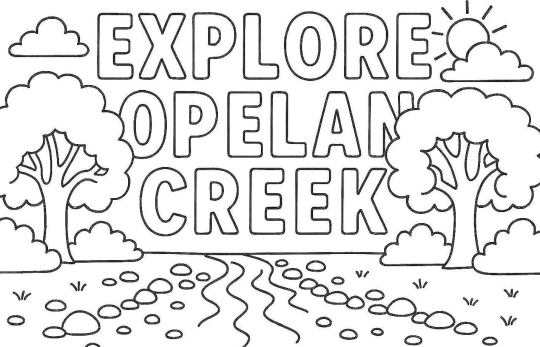
The water that flows through Copeland Creek drains off of the north-west side of Sonoma Mountain, carrying rocks and debris towards the Pacfic Ocean via the Russian River. Copeland Creek is the southernmost tributary of the Laguna de Santa Rosa Watershed, which is part of the larger Russian River Watershed. Learn about the water of Copeland Creek, and how it connects life, land and our community.
Each QR code comes with a coloring book page. You can also download the entire coloring book. Just click here or on the image to the right.
Copeland Creek
Starting high in the hills of the Sonoma State University-owned Fairfield Osborn Preserve, Copeland Creek is a perennial creek fed from natural springs. The creek winds its way through Rohnert Park and down to its final destination, discharging into Laguna de Santa Rosa. This land was historically home to the Pomo, Wappo and Miwok peoples. The creek is home to critical populations of amphibians, including the Pacific Giant Salamander and the rough skinned newt.
Today we experience an interplay between suburbanization and nature. Here, the footbridge at Snyder Road crosses over a spot where water flows, despite the fact that water is not readily present further upstream. Here at this nature and urban interface, the natural movement of water from the heights of Fairfield Osborn Preserve find their way to expanded suburban sprawl of modern Rohnert Park.
Haiku 1: Copeland Creek
Copeland Creek babbles
From high hill springs pouring forth
Down to Rohnert Park

*To download this coloring book page, Right Click (Windows) or CTRL-Click (Mac), and then click Save Image.
The Creek Bed
Here we can observe an unmanaged creek bed in all its splendor. The land here is replete with large rocks, arboreal break off, and invasive blackberries that thrive in the riparian pathway. The blackberry vines serve a major purpose: helping stabilize the underlying soil. Sonoma County is home to two different blackberry species: the native California blackberry and the invasive Himalayan blackberry. The California blackberry has three-lobed leaf clusters and fairly gentle thorns which produce small berries; while the Himalayan species has sharp thorns, five leaf clusters and generally larger fruit. Fighting the Himalayan blackberries, which overrun quickly, has been difficult for landowners and ecologists alike. During the rainy season, the ground cover in the creek helps to divert the high water volume coming directly from the dredged area to the due north of this location.
During the dry season much of the creek is hikeable but here the thriving of plant life make walking impassable. Stopping to observe this location, can you see any interplay between the creek and animal life? The vines provide homes for smaller animals and insects. The berries and insects provide foraging for the birds roosting in the coast live oaks above.
Haiku 2: Blackberry
Blackberry thorns dig
Deep into the soil here
Creek stability

*To download this coloring book page, Right Click (Windows) or CTRL-Click (Mac), and then click Save Image.
Dredging & Channelization
Oversight for Copeland Creek is provided by the Sonoma Water. Part of Sonoma Water's management involves occasional dredging to lower the ground level and widen the pathway of Copeland Creek. This reduction helps during the wet season to prevent localized flooding. This controlled management strategy is part of the channelization of Copeland Creek from Snyder Lane to downtown Rohnert Park.
As you observe this section of the creek, you will see a drop-off in the depth of the waterway occurs in this area due to dredging activity. The widening of the creek creates a natural sluice during the rainy season that pools up the precipitation buildup before slowing its flow further downstream.
Haiku 3: Dredging
Digging out the creek
Diverting to wider flow
Dimensionally

*To download this coloring book page, Right Click (Windows) or CTRL-Click (Mac), and then click Save Image.
The Role of the Pump Station
As a seasonal waterway, Copeland Creek does not feature a steady flow up and down the breadth of its run from Fairfield Osborn Preserve to Laguna de Santa Rosa. As such, the portion that runs from Snyder Lane to the Laguna is encouraged and strengthened in part by the pump station at this location. Inefficiency in both source and gravity flow requires a little man-made intervention to keep Copeland Creek flowing. Here the pump station can help with an inflow of water during the dry season.
But the pump station serves an even more important purpose during the rainy season, when it can divert water away to prevent flooding. The pump station is both an efficient and cost-effective solution for moving water in this challenging zone between housing and schools.
Haiku 4: Pump Station
Runoff from the rain
The pump station works its way
Clearing dirt and ground

*To download this coloring book page, Right Click (Windows) or CTRL-Click (Mac), and then click Save Image.
Bioswale
What do you notice here at the bioswale? A beautiful intermingling of plant life and soil earth are decidedly misleading.
Why? Because this area is in many ways manufactured.
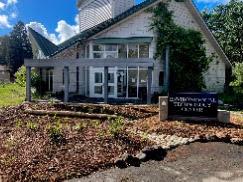
A bioswale is part of channel engineering designed to manage runoff, naturally filter pollutants and promote ground soil infiltration. Vegetation lies atop managed and imported soil, which resides above creek-bed stabilizing gravel.
The layered approach prevents dangerous erosion, while the vegetation stabilizes the soil.
The bioswale is managed by the Agroecology Garden and is the result of AJ Staal’s student project during the 2025-2026 academic year. Explore the bioswale in front of the Environmental Technology Center building. This bioswale is a creative, engineered way to protect our beloved creek.
The bioswale sits along the Copeland Creek Corridor, which is co-managed by Sonoma Water and the Center for Environmental Inquiry.
Haiku 5: Bioswale
The engineers made
A more substantial fusion
Man-made flow design

*To download this coloring book page, Right Click (Windows) or CTRL-Click (Mac), and then click Save Image.
Concrete & Asphalt
Here we can observe the concrete and asphalt construction of the pathway: an important walking and biking corridor along Copeland Creek. Concrete and asphalt are both exudative, meaning they have low capacity to absorb water. As such, during the rainy season, the runoff will largely slope slowly down to the creek. That produces increased water catchment.
But throughout the year, the concrete and asphalt walkway carries hundreds of walkers and bikers who can take in the beauty of the creekside views. In the balance between land maintenance and good stewardship of the land, we find the ways to integrate the two worlds of nature and utility.
Haiku 6: Concrete & Asphalt
Concrete meets asphalt
Evaporative assist
Nature comingled

*To download this coloring book page, Right Click (Windows) or CTRL-Click (Mac), and then click Save Image.
The High Point
Hikers and bikers alike can take a rest here. This outdoor seating is a great place to kick up your feet and take a look at the art building nearby. The Art Gallery was built partially using reclaimed materials. A recent exhibition even embraced this concept, as students from the Sonoma State University School of Arts presented works using reclaimed, recycled, and upcycled materials. Art is accessible to all, as it constantly reimagines and renews itself.
Speaking of accessibility, here the loose gravel stretch of the path gives way to pavement as the path continues its trek up Copeland Creek. This paved section of the trail makes enjoying the upcoming sights easier to access.
Haiku 7: High Point
High point of the march
Takes hikers to this very
Restorative place

*To download this coloring book page, Right Click (Windows) or CTRL-Click (Mac), and then click Save Image.
The Pond
Looking toward the pond, you will see a manufactured water catchment. Originally built for potential fire suppression purposes, the pond is a great place for observing wildlife. During the rainy season, pooling of water in these fields is common. Seasonally, this location would fill with water only to slowly drain out. However, for utility and aesthetic reasons, this area was eventually lined and ringed with a cement wall to provide a home for native fauna. Ducks and turtles are now tenants to this spot year round.
The pond also encourages time for observation and reflection. Are we pooling up things in our life only to let them slowly drain away? Or can we make a catchment so that something more beautiful remains?
Haiku 8: Pond
Cement bounded pond
Home for ducks and green turtles
Life thrives here beyond

*To download this coloring book page, Right Click (Windows) or CTRL-Click (Mac), and then click Save Image.
Water & Earth
Ask a geologist which is more important: water or earth. Their answer will invariably be BOTH. As we approach the footbridge, we can see an interplay between land and creek. Solid and liquid. Dry and wet. Without the solid and stable land to provide a baseline for Copeland Creek, the waterway would not be able to thrive.
There is a unison between land and water. A great unison. The relative absorptiveness of the land has a huge impact on the creek’s success. The natural alluvial stratification of the creek bed further encourages, stabilizes, and strengthens the creek. Look around and observe the gradient change between the land as it dips in toward Copeland Creek.
Haiku 9: The Geologist
The geologist
Knows water and earth function
In great unison

*To download this coloring book page, Right Click (Windows) or CTRL-Click (Mac), and then click Save Image.
Future Action
Restoration ecology is the science of repairing and assisting damaged, degraded, or destroyed ecosystems. In our high-tech, engine-driven, convenience-first 21st century, restorative ecological practices are necessary to assure that the relationship between humanity and nature is healthy.
Here we can observe Sonoma State University’s Kenneth Stocking Native Plant and Butterfly Garden. This project highlights a return to a more thoughtful and engaged connection with the land. Endemic species found here include native oaks, California yarrow, Baker’s manzanita, and dozens of others.
Take a moment to observe the rich floral life thriving here. Apps like iNaturalist can help identify plants that you may be noticing for the first time. Learn more about the Native Plant & Butterfly Garden.
Haiku 10: Native Garden
Standing at this spot
From the native plant garden
The creek flows and shines

*To download this coloring book page, Right Click (Windows) or CTRL-Click (Mac), and then click Save Image.
Creek Flow
Here is the entrance to the dirt trail as it heads north to south along Copeland Creek. If you look in the creek, you will see telltale signs of a shift in the size of the rock sediment—from larger to smaller—heading southward toward Snyder Lane. During the rainy season, the erosive and transportive nature of the flowing creek meet at a critical point here as the elevation drops in a slight gradient slope.
Take a moment on the meditation bench to reflect on the importance of Copeland Creek for this community and these plants and animals that call this waterway home. What can you hear in this spot? Take time to get in touch with the sensations you experience in this location.
Haiku 11: The Watershed
The great sense of touch
Embrace the riparian
Floral rich landscape

*To download this coloring book page, Right Click (Windows) or CTRL-Click (Mac), and then click Save Image.
Redwoods
As butterflies flit by, you can observe the redwoods present in this spot. Redwoods are essential to not just the soil health of this region but provide an important and unspoken absorptive role in moisture maintenance. We can especially observe that relationship during early morning fog. Redwoods and fog are the peanut butter and jelly of Sonoma County natural pairings. Redwoods can obtain up to 40% of their water from fog alone! Water particulates condense on redwood leaves and bark dripping down to the earth below, enriching and moisturizing the soil.
The majesty of the massive redwoods can overshadow how impressive the trees are at creating their own unique microclimates. Finally, during foggy times, the redwoods are bathed in a mystical beauty, making them even more beautiful. Take time to touch the redwoods and feel how the unique craggy bark allows space for increased absorption of moisture, including that clinging fog.
Haiku 12: Butterflies
Taking wing, aloft
Butterflies thrive on the creek
Flyers need water

*To download this coloring book page, Right Click (Windows) or CTRL-Click (Mac), and then click Save Image.
The content in this series was created and produced by SSU Professor Dr. Jackie Guilford and SSU student Brett Schmitt.