

Natural History of Copeland Creek Corridor
Waterways are regions if high biodiversity because all life requires water to survive. Learn about the land that the water flows through, and the plants and animals that call Copeland Creek home. Learn to identify plants, animals, and rocks and how each is part of the ecosystem
Nature-Urban Interface
iNaturalist is a free app where you can record your observations of plants, animals and fungi. You can identify their species, learn about them, and contribute to scientific research in just a few clicks!
For this activity, download the iNaturalist app and watch the short video below on how to use it.
If you prefer a simpler, playful alternative, go to site #8 and try out iNaturalist’s sister app Seek!
When you open the iNaturalist app, you will see a menu at the bottom of your screen with different icons.
For this activity click on the “explore” icon. This will show you a map.
You will be able to see the different observations others have made and recorded. These are represented by green pins. See how this works in the second video below.
For example, here we can see some of the species that have been observed locally, such as the Eastern Fox Squirrel, Snowy Egret, and Green Algae. You can also zoom in or out to explore your current location or delve into other areas of the world.
Do you notice a species that is commonly spotted? Choose another part of the world and compare the species that are commonly observed. Is there a big difference? Why do they vary, or why are they similar?
See how others are using iNaturalist!
How to make an observation on iNaturalist - iNaturalist (01:24)
How many species are in your backyard? - Be Smart/PBS (09:49)
Coast Live Oak Identification
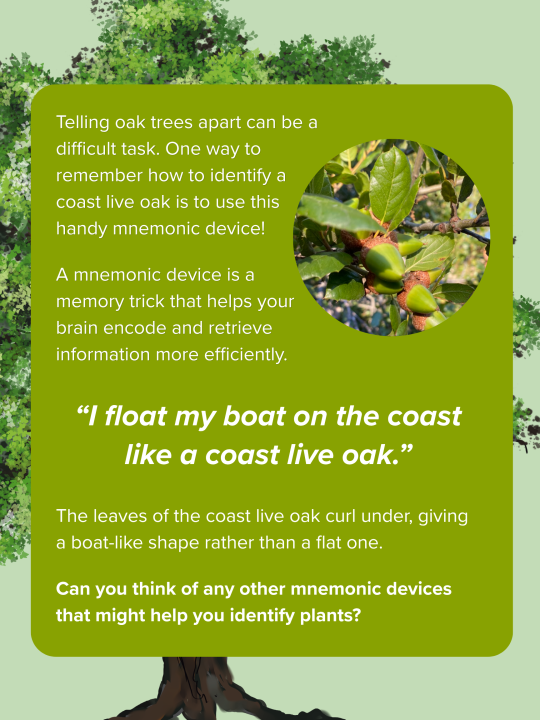
The tree in front of you is a Coast Live Oak. Its native range spans along the coastline from Mendocino County down into Baja California. This tree thrives in coastal habitats that provide fog. Oak trees are keystone species, meaning they play an important role in maintaining the health and stability of an ecosystem.
Get close to the tree and look at the shape, color, and texture of the leaves. These attributes help the tree to conserve water while still collecting enough sunlight to produce energy for acorn production.
Look at the bark of the tree. It is thick, which provides the tree a layer of protection and insulation against fire, bugs, and large animals.
Learn more at the California Native Plant Society.
Click on the images to download a PDF.
Sediment & Rock
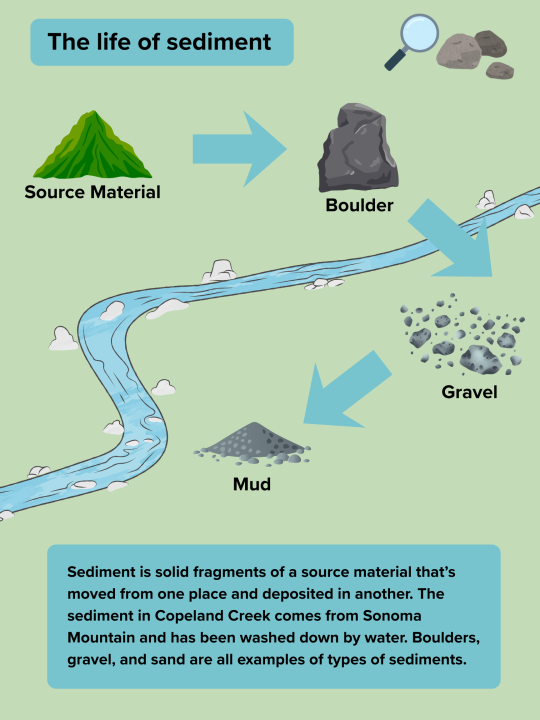
Sediment is solid fragments of a source material that’s moved from one place and deposited in another.
The sediment in Copeland Creek comes from Sonoma Mountain and has been washed down by fast- and slow-moving water. Boulders, gravel, and sand are all examples of types of sediment.
Click on the images to download a PDF.
Blackberries & Grasses
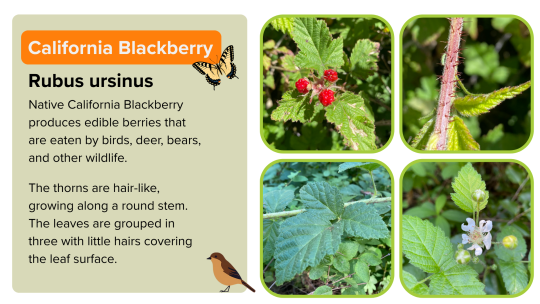
California blackberry is an important food source for people and wildlife. Native to California, this sprawling vining shrub is often low-growing and found near wetlands, stream banks, and forest edges. The thorns are soft and hairlike, growing along a rounded stem. The leaves are compound and grow in threes.
Learn more about native blackberry at the California Native Plant Society.
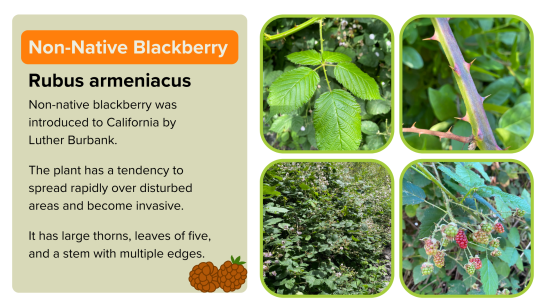
Himalayan blackberry is an aggressive, non-native invasive shrub that forms dense, thorny thickets that can cover large areas and suppress other plant life. It has large, triangular thorns that grow along a multi-sided stem. The leaves are oval and grow in fives. The berries are edible, however they are not as sweet as the California blackberry, and care should always be taken to avoid the thorns.
Learn more at the U.S. Forest Service.
Click on the images to download a PDF.
Native Foods
Long ago, humans and animals learned to cultivate this stunning land and harvest native foods, such as California blackberry, miners lettuce, and bay nuts from our California bay tree.
As you walk this trail, see if you notice any of these plants – and think about how people and animals use them.
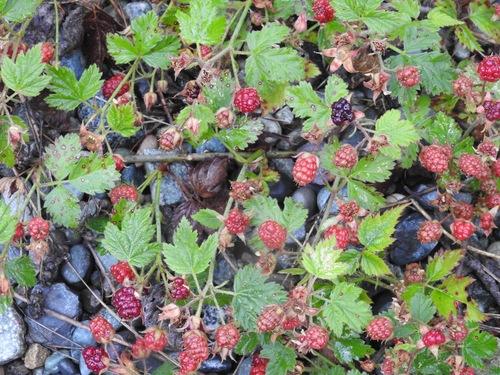
California Blackberry: The California Blackberry is part of the Rosaceae family – a native bush that grows throughout California and in some parts of Canada. It is a different species than the invasive Himalayan Blackberry, but both species are commonly found near streams and the coast. Blackberries play an important role in nature. Animals depend on blackberries as a food source and the bush for protection. Historically, people have also created teas and remedies from the plant and its berries.
Learn more from the Putah Creek Council and the Friends of Edgewood Preserve.
(Photo by mossytoes, used under CC-BY-SA-4.0)
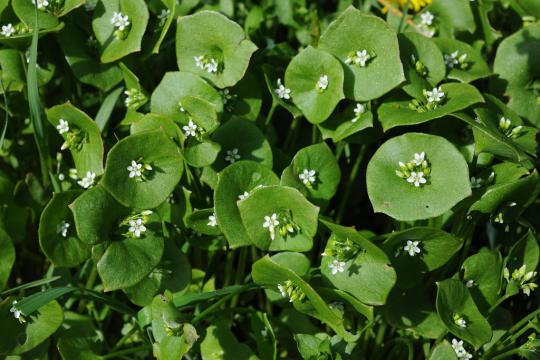
Miner’s Lettuce: Miner’s lettuce is part of the Montiaceae family and is a native herb that grows in Northern, Southern, and Central California. It typically grows up to 1-foot tall and is commonly found in shady, moist areas. Throughout the state’s history, people and animals would eat miner’s lettuce because it contains vitamin C, which prevents scurvy. People also use it to create teas, mild natural laxative remedies, and salads.
Learn more at the Kinnikinnick Native Plant Society, the Granada Native Garden Newsletter, and the Friends of Edgewood Preserve.
(Photo by Joost J. Bakker IJmuiden. used under CC-BY-SA-4.0)
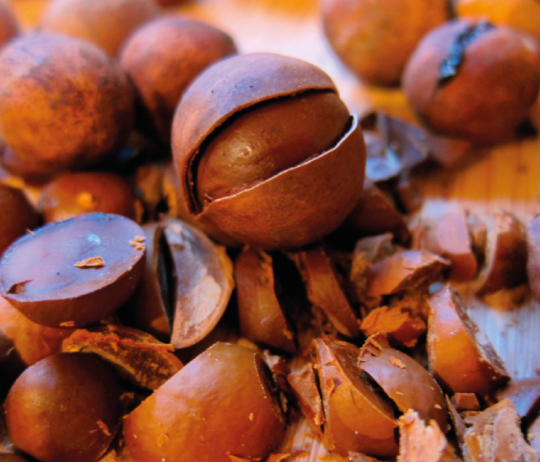
Bay Nuts: Grown from the native California Bay Tree, part of the Laurel family, Bay Nuts are edible seeds native to the Pacific coast of California and Oregon. It is commonly found in warm areas with small areas of shade. Animals rely on Bay Nuts as a food source. Humans used the seeds and leaves as medicine, food spice, soup, and insecticide.
Learn more at Lake County News and the Canopy Blog.
(Photo by Our Food. used under CC-BY-SA-4.0)
Nature's Calendar
Phenology is the study of life in relation to time. It studies things such as life cycles and how they are affected by seasonal changes like temperature, day length, etc.
For this activity you will be contributing to a phenology project right here on the SSU campus!
You just have to place your phone in the stand, take a picture right as it is, and upload it to <<this link ((coming soon))>>.
Here, you’ll be able to see how this specific spot on campus has changed throughout the day, the seasons, and even years!
Have you noticed any changes in your surroundings in the past couple of years? Think about when flowers bloom or when it gets dark. This is phenology!
Reuse & Recycle
Listen to and participate in this short audio activity.
Then, take the Climate Pledge!
Listen (00:59)
Transcript
Hello my nature friend. I have a quick fun activity for you today!
Take a moment to pause, breathe, and look around at your surroundings. Observe how many reused materials are around you.
Notice the redwood listening circle. Where do you think these redwood logs came from? Let me tell you. At SSU, when trees reach the end of their life cycle, they are cut down and composted, or reused on campus when possible. These reclaimed redwood trees were used to create this serene seating nook.
Now, let’s get more personal. How do you reuse materials from the Earth? Think about what you do on a daily basis with your trash. Do you recycle? reuse bottles? ride your bike instead of driving? Anything else?
As you think about what you can do, take our pledge to be more sustainable! It won’t take too long!
If you want to see progress, re-take this pledge multiple times over the next year or two, as many times as you wish, as you walk this beautiful creek. Over time, see if any of your responses change!
Thank you for tuning in, taking time to listen, and filling out our pledge! We truly appreciate you and we hope you had fun!
Seek
Seek is a fun, casual app that allows you to easily identify species with image-recognition technology.
Just take a picture of any animal, plant, or fungi, and Seek will determine its species and give you some information about it.
The best part: you can earn badges based on your observations and complete seasonal challenges!
Challenge your friends and family to see who can become the Seek master!
When you open up the Seek app, you’ll find suggestions of nearby species based on your current location.
To make an observation, just open up the camera at the bottom of the screen and capture the organism that you want to identify. The image-recognition software will do its best to give you an accurate name.
To add this species to your observations, just click the camera icon again to automatically save the picture to your device.
For example, <<you can see here ((coming soon))>> we have identified a Hairy Woodpecker, giving us a bronze bird badge.
The more species you observe, the more badges you’ll have!
If you want to be placed on the SSU Seek leaderboard, submit a screenshot of your badges to <<this link ((coming soon))>>.
Start your Seek journey by walking over to the lake. See how many birds or turtles you can identify!
How to use Seek (0:55)
\
More about seek from an active user (04:12)
Geologic History
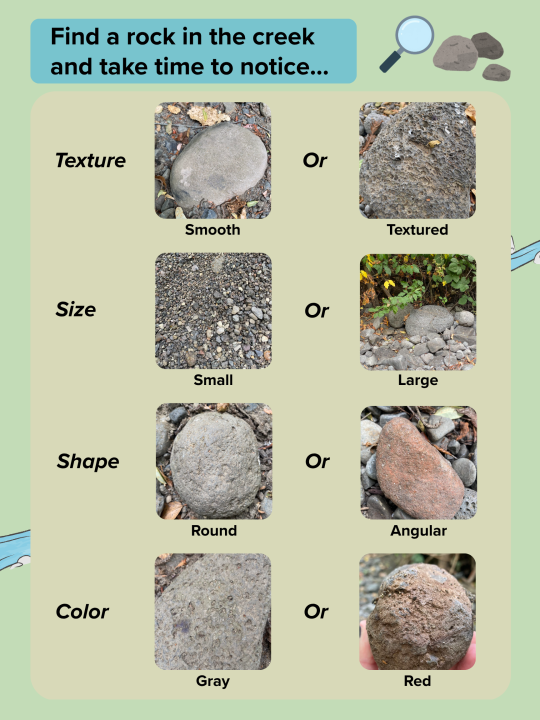
Learn about the complex geologic history of SSU and Sonoma County with the maps and rock descriptions of the ROCKD app. This region has sedimentary, igneous, and metamorphic rocks that have been formed by volcanic eruptions, deep burial, landslides, and flowing rivers.
Get close to the rocks behind you and notice the blue and green sparkles. These schists formed miles deep under great pressure, which you can see in the layers and folding, and were brought to the surface by faults. Join a Geology Walk on Fairfield Osborn Preserve to learn more.
Identifying Birds with Merlin
Merlin is a bird identification app developed by the Cornell Lab of Ornithology. It allows you to identify and record all your bird sightings with audio recordings, photos, and step-by-step descriptions.
Build your own Life List and take birdwatching to the next level!
When you open the Merlin app, it will ask you to enter your email address to create an account. You can do this or continue using the app without an account by clicking the skip button at the top right corner.
For this activity, click on the green sound button in the middle of the screen. This will record your surroundings, looking for bird songs, and give you species suggestions based on your location.
You can then save your recording and compare it to examples.
But what if you can see a bird but not hear it? With Merlin, you can also identify a species by uploading a photo or using the step-by-step guide where you can use information such as the location, size, color, and even behavior of the bird to identify possible species.
Walk around and keep your eyes and ears open and see how many birds you can find!
Explore the Merlin Bird ID App (03:16)
Complete Guide to the Merlin Bird App (09:33)
Forests vs. Meadows
Use the Native Plant Garden Map as you explore the trails — taking time to feel the tree bark, listen to the leaves rustling in the wind, and notice the dirt under your feet — and connecting with nature along the way.
As you explore, pay attention to each area and notice changes in mood, texture, and sound.
Take a moment to immerse yourself in the experience and engage your senses!
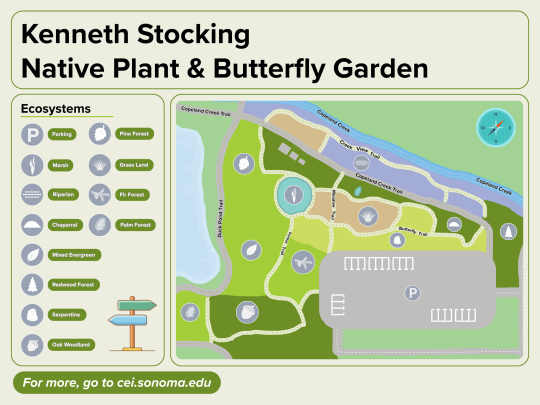
Click on image to take a self-guided virtual tour of the Kenneth Stocking Native Plant & Butterfly Garden
Redwoods & Fog
Coastal Redwoods are the tallest trees on Earth! These giants can grow to be more than 350 feet tall and live for up to 2000 years when undisturbed.
Coastal redwoods are native to a small, foggy coastal strip from central California to southern Oregon. Coastal fog is key to these trees' survival. As the fog gathers on the leaves, it is partially absorbed. The water that is not absorbed condenses into droplets that fall onto the forest floor, watering the plant life below.
Redwoods have shallow root systems that stretch out wide and interlock with other redwood trees, providing stability.
Learn more at the National Park Service.
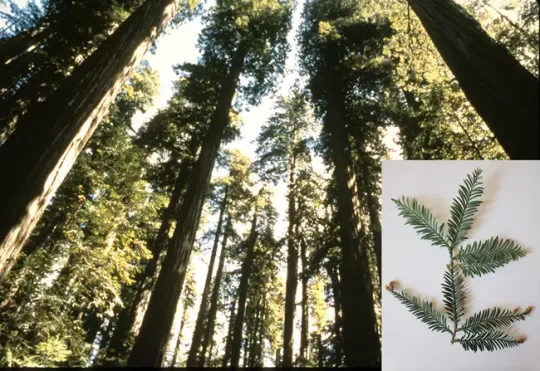
Coast Redwoods (photo courtesy of the National Park Service)
The content in this series was created and produced by SSU Geology lecturer Nicole Myers, and SSU students Tessa Thompson, Claudia Kamiya Shikina, and Nayeli Calvillo.